






 Trap
 Continuous
Dark Cure
View:
2818
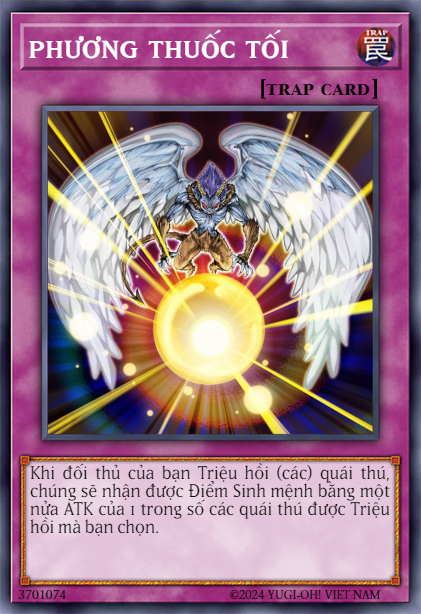
When your opponent Summons a monster(s), they gain Life Points equal to half the ATK of 1 of the Summoned monsters of your choice.
Dark Cure — Power Evaluation
Final Score: 41 ± 8 · Confidence: Medium
- Intrinsic: 41 · Deck: 42 · Meta: provisional
- Primary role: Utility · Secondary: Recovery/Recursion
Why it scores here
Dark Cure is a Continuous Trap whose only effect is to gain Life Points equal to half the ATK of one monster the opponent Summons. It converts no cards into board presence, card advantage, or disruption, so the combo, resource, and interaction axes stay low despite its 31-deck presence. Its score is carried by accessibility and cheap deck cost, because the card is run at 1 to 3 copies across 7 archetypes. High ATK on the opponent's monsters does not raise the score, since the effect scales only as a life gain.
Axis scores
| Axis | Score | Evidence |
|---|---|---|
| Accessibility | 55 | Played in 31 of the sampled decks at an average of 1.52 copies, mostly Chain Burn, so it is reliably available as a trap (observed). |
| Combo & Conversion | 15 | No recorded combo boards include it (0 appearances), and its text converts no summon into a board (verified from card text and combo data). |
| Resource Economy | 20 | The text gives Life Points only, with no draw, search, or card advantage (verified from card text). |
| Effect & Interaction | 25 | It is a passive life-gain effect with no negation, destruction, or summon restriction (verified from card text). |
| Material Utility | 0 | It is a Trap Card and cannot be used as Xyz, Synchro, Fusion, or Link material (verified from card type). |
| Resilience & Flexibility | 45 | It stays on the field as a Continuous Trap until removed, but it can be destroyed or negated by common trap removal (inferred from card type). |
| Deck-Building Efficiency | 60 | It is a single trap slot with a 1 to 3 copy spread across 31 decks and no garnet or lock restriction (observed from deck data). |
Calculation
Weight profile: Utility default profile (no clear primary role). Intrinsic ≈ 41, Deck ≈ 42, Meta = provisional. Modifiers: none. Final formula: 0.40*Intrinsic + 0.60*Deck
Strengths
- Cheap, flexible trap slot run across 7 archetypes
- Strong fit as a passive life-gain tool in the Chain Burn shell (observed in 19 of 31 decks)
Weaknesses
- No combo presence and no recorded board conversion
- No card advantage, no negation, and no board effect beyond life gain
- Zero material utility and a narrow, situational payoff
Counters / choke points
- Trap removal or destruction that clears the Continuous Trap (inferred)
- Opponent's counter-traps or negation effects that stop the trap from resolving (inferred)
Best use
Passive life gain in trap slots against summon-heavy opponents. Decks: Chain Burn, Darklord. Suggested copies: 1.
Evidence & gaps
- Verified: Continuous Trap that gains LP equal to half the ATK of one Summoned monster (card text); No combos recorded (combo data)
- Observed: Present in 31 of the sampled decks, averaging 1.52 copies (deck data); Chain Burn is the dominant home at 19 of 31 decks (deck data)
- Inferred: Passive life gain is a supporting role rather than a primary win condition; Deck resilience is moderate because the card depends on the opponent summoning monsters
- Data gaps: no combos supplied — combo conversion is text-only inference no banlist token — assumed 3 copies (unlimited) no usage statistics (StatisticsCard) — archetype inclusion % inferred from deck sample only